
Slide Gate Engineering Guide
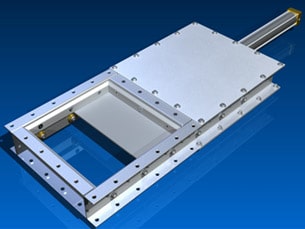
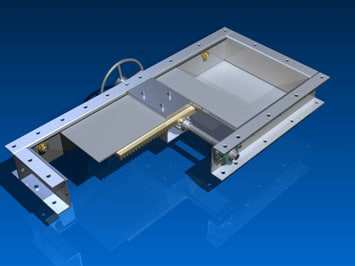
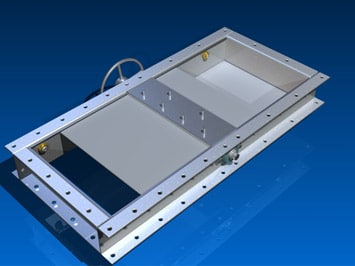
KWS Slide Gates are used to control the discharge of bulk materials from hoppers, bins, silos or conveyors. Slide Gates consist of a rigid frame with a slide plate located inside that opens and closes against the flow of material. The slide plate can be actuated by manual, pneumatic, electric or hydraulic means.
The slide plate is supported by frictionless rollers to allow for easy actuation. The slide gate assembly utilizes bolted covers on both the top and bottom to create a dust-tight enclosure while allowing easy access for maintenance. KWS Slide Gates are a great complement to our bulk material handling and processing equipment.
Slide Gates Engineering Guide – Index
Features & Benefits
Typical Applications for Slide Gates
- Located at intermediate discharge points on conveyors for evenly loading trucks
- Located at the discharge of a silo to cut-off the flow of bulk materials to a feeder
- Located below a centrifuge to divert liquids to a drain and solids to downstream shaftless crew conveyors
KWS Slide Gates make plant layout much more efficient. Intermediate discharge points with slide gates can be added to a conveyor so several different process lines can be fed with bulk materials by opening and closing KWS Slide Gates as required.
KWS Slide Gates are custom designed for your application based on proven design standards. Bulk materials ranging from free-flowing cement to sluggish dewatered biosolids can be controlled using KWS Slide Gates.
Frequently Asked Questions
What is a Slide Gate?
A slide gate is a mechanical device used to control the flow of bulk materials from conveying equipment, bins, hoppers, silos, and chutes. Slide gates operate by moving a flat plate, or blade, across an opening to start, stop, or restrict bulk material flow. They are commonly used as isolation devices to shut off bulk material flow for maintenance or emergency shut down situations.
Slide gates can be manually operated or actuated using pneumatic, hydraulic or electric linear actuators. While some slide gates are designed for simple on/off service, others are engineered to regulate bulk material flow by precisely controlling the slide plate position.
Can slide gates actuate under a load?
Slide gates can be engineered to perform reliably under a wide range of operating conditions. By considering design factors such as material density and the height of material above the gate, the appropriately sized actuator can be selected to ensure smooth and consistent operation in loaded applications.
Can a slide gate be used for the discharge of abrasive bulk materials?
KWS slide gates are designed to handle a wide range of bulk materials including abrasive bulk materials. As optional features, bronze wipers with an abrasion resistant slide plate and deflectors are utilized to combat the abrasiveness of many bulk materials.
What is a slide plate used for?
A slide plate is a major component of a slide gate and is the barrier that prohibits material flow through a slide gate when closed. When the slide plate is opened, material can freely flow through the opening of the slide gate.
What is the difference between a manual, pneumatic, electric, and hydraulic slide gate?
The primary difference between these slide gates is the method of actuation. Manual slide gates require physical operation by turning a hand wheel through a rack and pinion while pneumatic actuators use compressed air to either open or close the slide gate. Electric slide gates use linear actuators to set the gate opening to any point from fully open to fully closed. Hydraulic actuators work similarly to pneumatic actuators but use hydraulic fluid to operate the slide gate.
Where are slide gates commonly installed in a bulk material handling system?
Slide gates are commonly used on screw conveyors with multiple discharge points to distribute bulk materials to other areas of a process. Slide gates can also be located under hoppers, bins, or silos to control flow or use for maintenance purposes.