
Bucket Elevator Engineering Guide
One of the most efficient ways to elevate bulk materials vertically is with a bucket elevator. A Bucket Elevator consists of a series of buckets attached to a belt or chain with pulleys or sprockets located at the top and bottom of the unit. The buckets are located in a casing or housing to contain the material.
Bucket Elevator Engineering Guide – Index
- Applications and Materials
- KWS Design Standards
- KWS Dimensional Standards
- Horsepower Calculation
- Capacity Tables
Features & Benefits
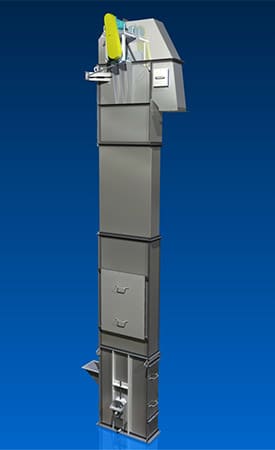
Bulk materials are loaded into each bucket as the bucket moves past an inlet point. KWS designs and manufactures a wide variety of bucket elevators based on the characteristics of the bulk material and the process requirements.
Advantages of Using Bucket Elevators
- Designed to handle a wide variety of bulk materials – from average to very free-flowing
- Many different bucket and casing sizes available for capacities up to 15,000 cubic feet per hour
- Completely enclosed for dust and weather-tight operation
- Inlet section can be control fed or flood loaded with bulk materials
KWS designs and manufactures Bucket Elevators to meet the needs of many industries, such as Chemical, Minerals Processing, Food, Wood Products and Wastewater Treatment.
Frequently Asked Questions
What is a Bucket Elevator?
A bucket elevator is a mechanical conveying device designed to move bulk materials vertically using a series of buckets attached to a belt or chain. The buckets scoop material at the inlet, typically from a hopper or chute, and carry it upward to a discharge point where the material is released by centrifugal force or gravity.
Bucket elevators are commonly used for handling dry, free flowing bulk materials such as grain, sand, cement, fertilizers, and pellets. The main components include the head section with the drive and discharge, the boot section where material is loaded and tension is adjusted, and the intermediate casing that encloses the belt or chain and buckets.
For more information, please review our Bucket Elevator Engineering Guide.
What is the difference between a Centrifugal Bucket Elevator and a Continuous Bucket Elevator?
The primary difference between centrifugal and continuous bucket elevators is how material is discharged and how gently the material is handled. A centrifugal bucket elevator uses spaced buckets running at higher speeds. Material is discharged by centrifugal force as the buckets pass over the head pulley. This design is ideal for free flowing, non-fragile materials such as grain, sand, or pellets where high capacity and simple construction are desired.
A continuous bucket elevator uses closely spaced buckets and operates at a much slower speed. Material is discharged by gravity as it flows from one bucket into the next at the head pulley. This design minimizes product degradation and is best suited for fragile, abrasive, or sluggish materials such as fertilizers, chemicals, and food products.
What is the difference between belt and chain bucket elevators?
Belt type bucket elevators are ideal for general-purpose applications, offering smoother operation and the ability to run at higher speeds. Chain type bucket elevators are better suited for heavy-duty applications and can be engineered to handle more demanding conditions.
What makes a bucket elevator ideal for vertical conveying?
Bucket elevators have many advantages when compared to other types of mechanical conveyors for elevating bulk materials. Some advantages include –
- High Capacity
- Small Footprint
- Low Energy Requirements
- Completely Dust Tight
- Low Maintenance
Please refer to the KWS Bucket Elevator Engineering Guide or contact KWS for more information.
How high can a bucket elevator elevate a bulk material?
Bucket elevators can elevate many bulk materials over 200-feet vertically while maintaining a relatively small footprint. Specific height restrictions depend on bulk material density, capacity, and horsepower requirements. In general, dense bulk materials require more horsepower to elevate. Typically, bucket elevator heights can easily be over 100-feet tall. Most KWS bucket elevators are designed to be free-standing and can be anchored laterally to a structure or silo.
Can bucket elevators handle dusty bulk materials?
Bucket elevators are commonly used for elevating dusty bulk materials because their enclosed construction contains airborne dust. Vent connections and dust collection interfaces can also be incorporated when necessary to further improve dust control.
KWS standard bucket elevator design includes adjustable split gland seals on both the head and boot shafts to completely contain bulk materials and dust within the bucket elevator.