
Shaftless Screw Conveyor Engineering Guide
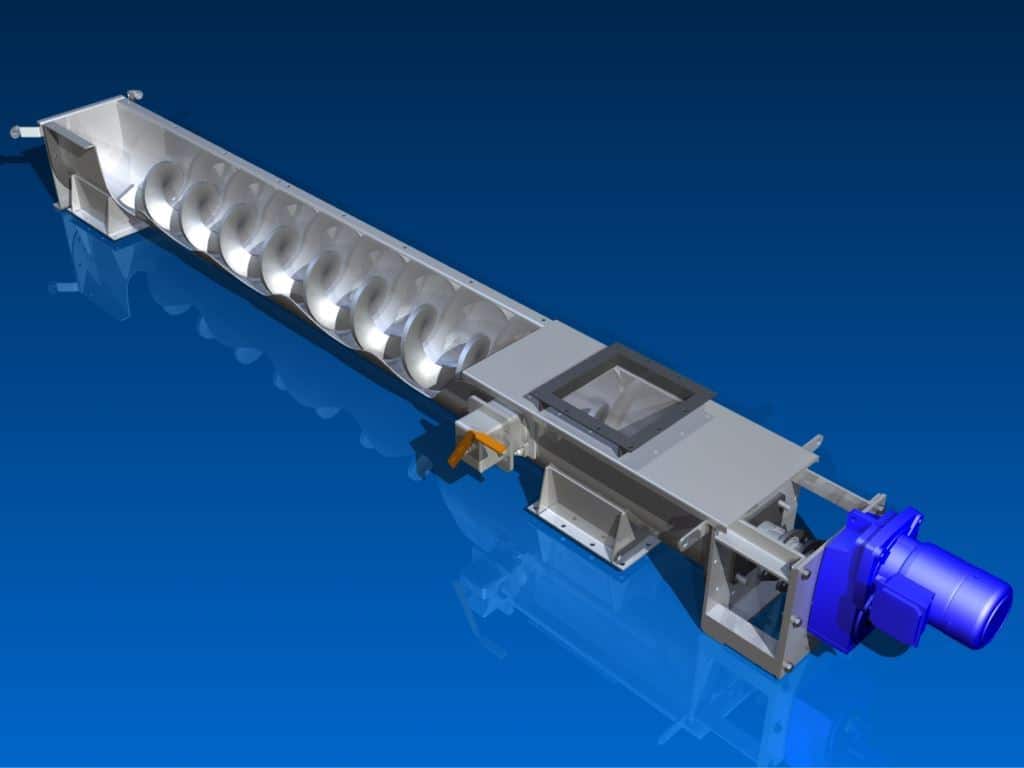
KWS Shaftless Screw Conveyors are highly efficient at metering and conveying a variety of bulk materials. Better performance is achieved through zero-clearance between the trough and spiral, improving conveying efficiency and eliminating many of the flow-impeding issues common with shafted screw conveyors.
Higher trough loading allows for lower operating speeds. Lower capital cost and lower overall maintenance costs are realized from equipment designed to require fewer parts. KWS Shaftless Screw Conveyors are designed for greater flexibility and efficiency in plant layout, providing for end-to-end, side inlet/discharge and vertical configurations.
Shaftless Screw Conveyor Engineering Guide – Index
Features & Benefits
Advantages of Using Shaftless Screw Conveyors
- Ideal for handling free-flowing to sticky and sluggish bulk materials
- Improved conveying efficiency when compared to other types of conveyors
- Greater flexibility for plant layout due to multiple configurations available
- Internal bearings are eliminated
Every KWS conveyor system is manufactured in the USA by highly skilled craftsmen dedicated to producing quality products every day. KWS designs and manufactures shaftless screw conveyors to meet the needs of many industries, including chemical, rendering, wood products and wastewater treatment. KWS Shaftless Screw Conveyors efficiently convey dry, semi-fluid or sticky bulk materials. The shaftless design provides a non-clogging conveying surface by eliminating the need for intermediate shaft bearings.
Bulk materials discharged from centrifuges, filter presses or mixers can easily be metered or conveyed using a shaftless screw conveyor. The perfect solution for handling bulk materials with high moisture content is the KWS Shaftless Screw Conveyor.
KWS developed the industry standards for shaftless screw conveyors and continues to create new and improved design standards. The KWS-350 high strength alloy spirals are the strongest, hardest and toughest in the industry.
Frequently Asked Questions
What is a shaftless screw conveyor?
Shaftless screw conveyors feature a continuous, non-clogging conveying surface without a center pipe, making them ideal for handling sticky, sluggish, high-moisture, and other difficult-to-convey materials. By eliminating the center shaft, these conveyors minimize material buildup and allow materials that would typically adhere to a traditional shafted screw to be conveyed efficiently and reliably. Shaftless screws ride on liners within the conveyor trough creating zero clearance between the spiral and trough.
For more information, please review our Shaftless Screw Conveyor Engineering Guide.
Can a shaftless screw conveyor be used as a screw feeder?
KWS does not recommend using shaftless screw conveyors as screw feeders. Screw feeders are flood-loaded in the inlet section and use variable pitch or mass-flow screw designs to accurately control the feed rate. Most shaftless screws are constant pitch and diameter and are not conducive to flood-loaded conditions.
How do I know when to replace the liners in my shaftless screw conveyor?
Shaftless screw conveyors require periodic inspection to determine liner wear. KWS recommends monthly inspections to keep your shaftless screw conveyor operating without downtime. Liners that are worn more than ¼-inch require replacement. KWS offers dual-colored liners that indicate when a liner section has worn to a certain thickness by revealing a different color to prompt replacement.
What is the difference between shafted and shaftless screw conveyors?
Both shafted and shaftless screw conveyors transfer bulk materials with each screw rotation. Shafted screw conveyors utilize screw sections that are mounted on a center pipe. The center pipe transmits power to the screw sections and supports the screw in the trough. Shaftless screws or spirals do not have a center pipe. Power is transmitted to the spiral using a bolted flange connection to the drive unit. The spiral is supported by wear liners in the trough.
How long can a shaftless screw conveyor be?
Shaftless screw conveyors convey bulk materials using a shaftless spiral without the need for a center pipe. Horsepower and torque are transmitted through the length of the shaftless spiral to convey the bulk material. As the length of a shaftless screw conveyor increases, more horsepower and torque are required to convey the bulk material.
The length of a shaftless screw conveyor is limited by the torque rating of the shaftless spiral. Typically, 100 feet is the limit for overall length. KWS performs engineering analysis and calculations to determine maximum overall length of a shaftless screw conveyor.