
Screw Conveyor Engineering Guide
The KWS Screw Conveyor Engineering Guide will provide assistance in the design of a screw conveyor or system, yielding optimum performance and efficiency.
Screw Conveyor Engineering Guide – Index
- Types of Screw Conveyors
- Types of Screw Feeders
- Bulk Material Characteristics
- Component / Bearing Series
- Factors Influencing Screw Conveyor Design
- Bulk Material Table
- Screw Conveyor Capacity
- Screw Conveyor Horsepower
- Screw Conveyor Torque
- Screw Conveyor Example
- Dimensional Layout of a Screw Conveyor
- Interactive Calculators
Primary considerations for the selection of a screw conveyor are:
- Type and condition of the bulk material to be conveyed including maximum particle size and specific bulk density
- Capacity or feed rate of bulk material to be conveyed expressed in pounds per hour, tons per hour, or cubic feet per hour
- Required distance and incline the bulk material is to be conveyed
- Design conditions such as materials of construction, inlet feed conditions and operating temperature
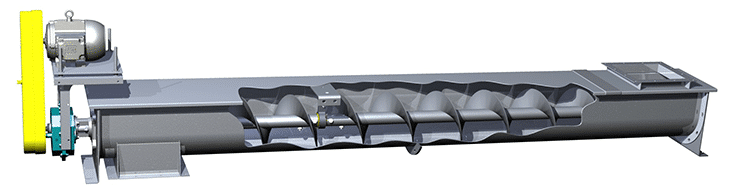
Typical KWS Screw Conveyor
The Engineering Guide provides the necessary information for selecting a screw conveyor in a series of five steps. These steps are arranged in logical order and are divided into separate sections for simplicity.
The five steps are:
- Establish characteristics of the bulk material to be conveyed.
- Determine conveyor size and speed based on capacity.
- Calculate horsepower requirements.
- Verify torque rating of components.
- Select conveyor components.
Frequently Asked Questions
What is the difference between a screw conveyor and a screw feeder?
Although they look similar, screw conveyors and screw feeders are designed for very different functions. A screw conveyor is intended to transfer bulk materials from one point to another at a consistent trough loading. The goal is to efficiently transport a constant and pre-regulated flowrate of bulk materials. Screw conveyors typically use a uniform screw pitch and always operate under control fed conditions.
A screw feeder is designed to meter bulk materials at a consistent and predictable rate. Screw feeders regulate flow from hoppers, bins, or silos into downstream equipment. To achieve accurate feeding, screw feeders use a variable screw pitch with flights that are closer together in the inlet area and flights that are further apart after the inlet. Screw feeders always operate under flood fed conditions.
Watch our video to learn more.
How do I know if a screw conveyor is the right choice for my bulk material?
Screw conveyors easily convey various bulk materials for a wide range of applications. KWS has over 200,000 installations handling thousands of different bulk materials. Please refer to our Screw Conveyor Engineering Guide to determine if a screw conveyor would best suit your bulk material and application requirements.
How should a screw conveyor be aligned during installation and before operation?
Proper alignment is necessary for trouble-free operation of a screw conveyor. A string line can be attached to the side of the trough ends on each end of the conveyor. The string line provides a reference to measure variations in distance from the trough to the string along the full length of the conveyor. Please refer to the KWS Operations and Maintenance Manual for complete details.
What is the difference between a speed switch and a speed sensor?
Speed sensors detect speed changes in rotating equipment such as screw conveyors, bucket elevators, drag conveyors or belt conveyors. Zero speed switches are very similar to speed sensors but detect the lack of speed or zero speed in rotating equipment.
Speed sensors and zero speed switches are used to protect personnel, equipment and processes. When the sensor or switch detects a change in speed or zero speed, a signal is sent to a control panel or an alarm to alert the operator of a malfunction. The process may be halted to prevent damage to other conveying or processing equipment.
Speed sensors are typically non-contacting proximity type that detect a target attached to the shaft of the rotating equipment. A speed sensor can also detect movement using the flight of a screw conveyor, buckets of a bucket elevator, or paddles of a drag conveyor. Some speed sensors can be used as tachometers to measure the actual speed of the rotating equipment.
Speed switches are typically mechanical and directly connected to the shaft of the rotating equipment. Mechanical zero speed switches have internal switches that open or close when the shaft stops rotating. Speed sensors and zero speed switches are available with both analog and digital outputs.
For more information, please review our Speed Sensor and Speed Switch Features & Benefits:
What does an E-Stop do?
A cable-operated emergency stop system is meant to increase safety for personnel working around a conveyor. The activation cable is routed along the full perimeter of the equipment, allowing operators to quickly shut down the system from any point in the event of an emergency.