
Is it common for screw conveyors to be “coped” together?
Question
I have two screw conveyors that intersect with each other and there is not enough room for standard inlet and discharge transitions. Is it common for screw conveyors to be “coped” together when required?
Answer
Coping refers to the process of making precise cuts, contours, or curves in a material. While many associate the term with woodworking and the traditional use of a coping saw, the concept applies to metal fabrication as well including the construction of screw conveyors.
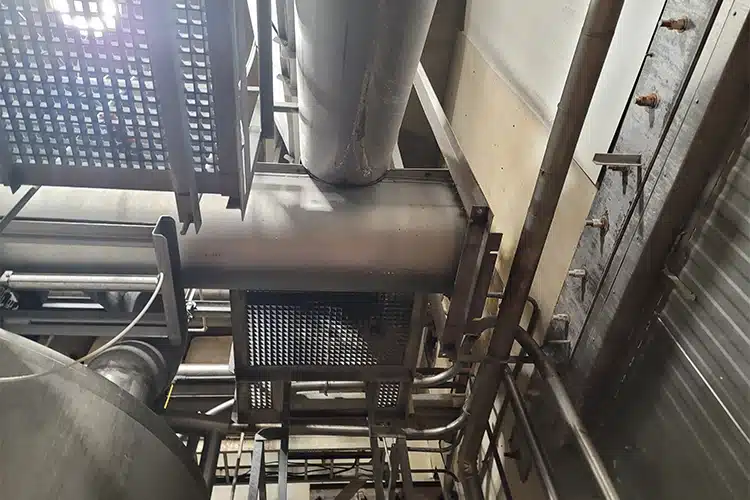
Limited Space Requires Two Screw Conveyors to be Coped
In certain applications, screw conveyors must be coped together, meaning one conveyor flight or housing must be precisely contoured to fit into the side of another conveyor, a storage bin, or any other receiving vessel. This requires extremely accurate cutting at the point of entry so that the two components fit together seamlessly.

Key-Hole Trough Screw Conveyor is Coped to Fit to Surge Bin
Using tools such as a plasma cutter, oxy fuel torch, or cutting wheel, fabricators can match the geometry of the receiving surface with high accuracy. When executed correctly, this allows the adjoining unit to be welded into place with minimal grinding, rework, or dimensional adjustment, ensuring a clean, sanitary, and structurally sound fit.

Accurate Cutting and Fit Up is Important for Success

Eliminating Transitions Creates More Efficient Operations