
Wear Bars vs. Liners for Poultry Screw Conveyors
Question
I am designing a screw conveyor for animal processing in a poultry plant. The conveyors cannot have intermediate hanger bearings, so the screws will ride on the troughs. I know I need a wear surface to protect the trough. I have heard of wear bars and liners, but I am not sure which one is best for my application. I would also like to know about the various materials available for both products. Which option should I use?
Answer
Wear bars and liners both protect the trough and provide a sacrificial wear surface, but they are used for different purposes. A trough liner is formed to fit the inside contour of the trough and covers a large portion of the curved surface. Liners are typically used when the priority is trough protection, abrasion resistance, or reduced clearance between the screw and trough.
Wear bars are narrow strips installed longitudinally in the trough. They provide raised riding surfaces for the screw while leaving open areas between the bars for liquid drainage. In poultry processing, especially feather conveying, wear bars are often the best choice because excess moisture can drain beneath the product. Wear bars can also create a rifling effect that helps move feathers more efficiently through the conveyor.
Liners and wear bars for poultry processing applications are commonly made from carbon steel, abrasion resistant AR235, or AR400. KWS does not recommend running 304 stainless screws directly on 304 stainless liners or wear bars because stainless-on-stainless sliding contact can gall and cause rapid wear.
The two common bulk materials conveyed by screw conveyors in poultry plants are offal and feathers. For feather applications, carbon steel wear bars are the most common solution because they provide a defined riding surface and allow moisture to drain. For offal applications, AR400 liners are the most common solution because they provide broad trough protection and excellent abrasion resistance.
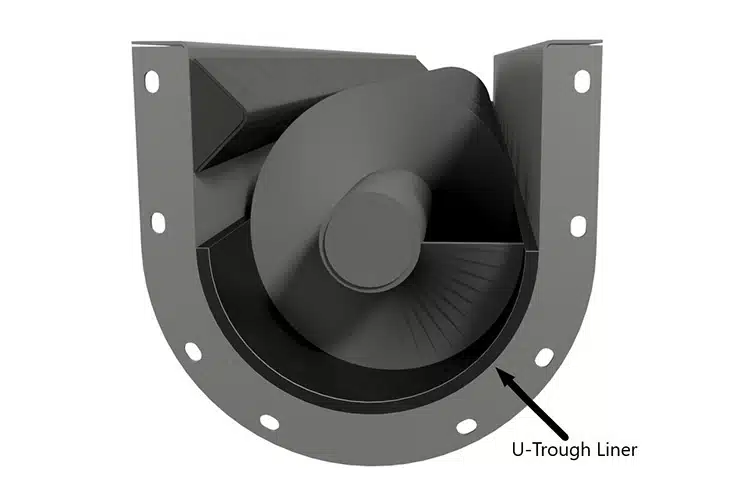
Trough Liners Fit Inside Contour and Cover Large Area
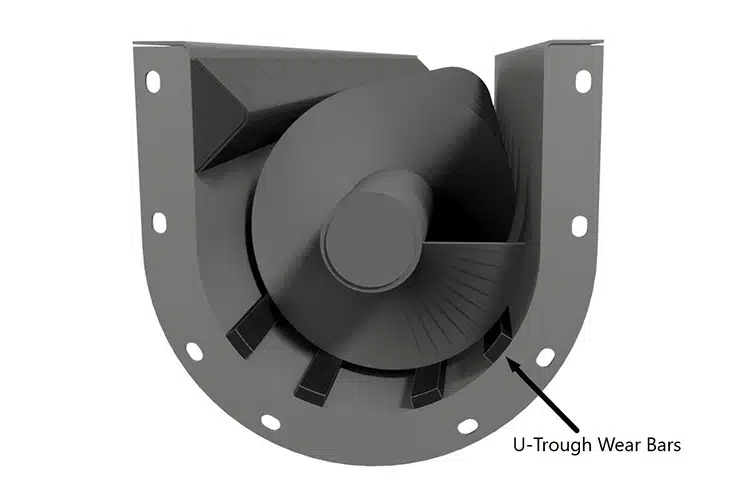
Wear Bars Leave Open Areas for Liquid Drainage